AI Inventory Management: Transforming Stock Control in the Digital Era

Inventory management has always been a balancing act. Businesses need enough stock to meet customer demand without tying up money in excess inventory. When this balance is difficult to maintain, companies can face stockouts, overstocking, wasted storage space, and unnecessary operating costs.
Traditional inventory processes often depend on historical reports, spreadsheets, manual stock checks, and fixed reorder points. These methods can work for simple operations, but they become harder to manage as product ranges, order volumes, and supply chains grow.
This is where AI inventory management is changing the approach. By analyzing large amounts of operational data, AI can help businesses forecast demand, monitor stock levels, improve replenishment, and identify potential inventory problems earlier.
What Is AI Inventory Management?
AI inventory management uses artificial intelligence to analyze inventory data and support decisions related to stock planning, forecasting, replenishment, and control.
Instead of relying only on fixed rules or historical averages, AI can identify patterns across sales, seasonal demand, purchasing behavior, lead times, and inventory movements.
For example, an AI system can detect that demand for a particular product is increasing and recommend replenishment before stock levels become critical.
This makes inventory management more responsive to changing business conditions.
Why Traditional Inventory Control Is No Longer Enough
Traditional inventory management typically relies on predefined reorder points and manual monitoring. While these approaches are straightforward, they may not respond quickly when demand or supply conditions change.
Consider a business dealing with hundreds or thousands of products. Monitoring every item’s sales pattern, supplier lead time, stock level, and demand fluctuation manually becomes increasingly difficult.
This is where AI for inventory management can provide an advantage. AI continuously analyzes data and helps teams identify changes that may otherwise be missed.
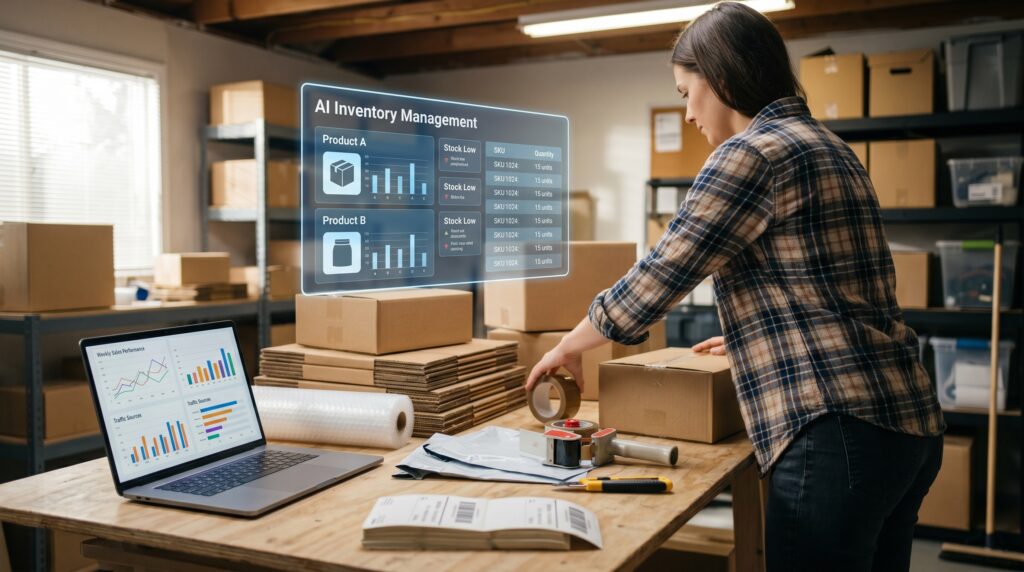
How AI Is Transforming Inventory Management
1. More Accurate Demand Forecasting
Demand forecasting is one of the most important applications of AI.
AI analyzes historical sales, seasonal patterns, customer behavior, and other relevant data to estimate future demand.
Better forecasts help businesses determine how much inventory they may need and when they should replenish it.
This can reduce both stockouts and excess inventory.
2. Smarter Replenishment
Knowing when to reorder inventory is just as important as knowing how much to order.
AI inventory management systems can consider current stock levels, supplier lead times, demand forecasts, and order patterns when recommending replenishment.
Instead of relying on a fixed reorder point, businesses can use dynamic recommendations that change as conditions change.
3. Real-Time Inventory Visibility
Accurate inventory information is essential for effective decision-making.
AI can combine information from warehouses, sales channels, purchasing systems, and other sources to provide a clearer view of available inventory.
A modern AI-powered inventory management system can also identify unusual stock movements and highlight discrepancies that require attention.
4. Reducing Overstock and Stockouts
Both excess inventory and stock shortages can negatively affect a business.
Overstock ties up capital and increases storage costs, while stockouts can result in missed sales and dissatisfied customers.
AI for inventory management helps businesses find a better balance by analyzing demand patterns and identifying products that may be at risk of becoming overstocked or running out.
5. Identifying Slow-Moving Inventory
Some products may remain in storage for long periods without generating sufficient demand.
AI can analyze product movement and identify slow-moving or obsolete inventory.
Businesses can then make informed decisions about promotions, purchasing, storage, or product discontinuation.
Benefits of AI Inventory Management
The value of AI inventory management extends beyond simply knowing how much stock is available.
Businesses can benefit from:
- Improved demand forecasting
- Better replenishment planning
- Reduced inventory carrying costs
- Fewer stockouts
- Improved inventory accuracy
- Better use of warehouse space
- Faster decision-making
- Greater visibility across inventory operations
These benefits can become particularly valuable as businesses manage larger product catalogs and more complex supply chains.
Practical Use Cases of AI in Inventory Management
AI can support inventory decisions across several industries.
Retail and E-Commerce
Retailers can use AI to forecast demand across products and locations, helping them maintain stock levels that reflect changing customer behavior.
Manufacturing
Manufacturers can use AI to coordinate raw material inventory with production requirements and supplier lead times.
Distribution
Distributors managing large product catalogs can use AI to identify demand patterns, optimize replenishment, and reduce slow-moving stock.
Warehousing
Warehouse operators can combine AI inventory management with warehouse management systems to improve stock visibility, storage decisions, and replenishment workflows.

Challenges Businesses Should Consider
AI can improve inventory control, but implementation requires careful planning.
Data Quality
AI depends on accurate data. Inconsistent product information, missing sales records, or inaccurate stock counts can affect the quality of AI recommendations.
System Integration
An AI-powered inventory management system may need to connect with ERP, warehouse management, procurement, and sales platforms. Poor integration can create data gaps and limit the value of the technology.
Employee Adoption
AI should support inventory teams rather than operate as a disconnected system. Employees need to understand how recommendations are generated and when human judgment should override them.
Implementation Costs
Businesses should evaluate the expected return before investing in AI. Starting with a specific inventory challenge can make implementation easier to manage and measure.
The Future of AI Inventory Management
The future of AI inventory management is moving toward more predictive and autonomous operations.
AI systems will increasingly move beyond reporting what happened and help businesses determine what is likely to happen next and what action should be taken.
AI agents could monitor inventory levels, detect emerging shortages, evaluate supplier lead times, and recommend or initiate replenishment actions based on predefined business rules.
This shift could make inventory operations faster and more responsive while reducing the amount of manual monitoring required.
Final Thoughts
Inventory control is becoming increasingly data-driven. Businesses can no longer rely solely on historical averages and manual stock checks when demand, supply conditions, and customer expectations can change quickly.
AI inventory management gives businesses a way to analyze these changes and make more informed decisions about forecasting, replenishment, stock levels, and inventory performance.
The most effective approach is not to automate every inventory decision immediately. Businesses should identify areas where inaccurate forecasting, excess stock, stockouts, or manual processes are creating measurable problems, then apply AI where it can deliver practical value.
As AI-powered inventory management systems continue to evolve, they will play an increasingly important role in helping businesses build more efficient, responsive, and data-driven inventory operations.
FAQs
1. What is AI inventory management?
AI inventory management uses AI to analyze inventory data and improve forecasting, replenishment, stock control, and inventory-related decision-making.
2. How does AI improve inventory management?
AI for inventory management can analyze demand patterns, monitor stock levels, predict shortages, identify slow-moving products, and recommend better replenishment decisions.
3. What is an AI-powered inventory management system?
An AI-powered inventory management system is software that uses artificial intelligence to automate or support inventory forecasting, monitoring, replenishment, and analysis.
4. Can AI reduce inventory costs?
Yes. By improving demand forecasting and replenishment decisions, it might help businesses reduce excess stock and avoid unnecessary storage costs.